Summary
California's Court of Appeal just voided Blue Origin's employment arbitration agreement on four independent grounds, finding it overbroad, one-sided, and riddled with unlawful waivers. If your company uses a standard arbitration agreement, this decision is your cue to have it reviewed.
If your company uses a standard employment arbitration agreement, the California Court of Appeal just handed you a reason to pull it out and read it carefully. Not because of a federal statute that’s been generating headlines. Because of California’s own unconscionability doctrine, applied with a level of specificity that should make any employer uncomfortable if the last time anyone reviewed that agreement was more than a few years ago.
The case is Stoker v. Blue Origin, LLC (Cal. Ct. App., 2d Dist., No. B344945, Apr. 24, 2026), and it does not require space-industry facts to be relevant to your business. It requires only that you be a California employer who hired someone, handed them a take-it-or-leave-it arbitration agreement as a condition of employment, and assumed the agreement would hold up.
The Facts That Got Blue Origin Here
Craig Stoker joined Blue Origin in August 2020 as a senior director of program management. Like most employees at large companies, he signed an arbitration agreement at the time of hire. By his account, a company recruiter told him the agreement contained standard terms, that everyone had to sign it, and that everyone always did. Blue Origin presented no evidence that any of the terms were negotiable.
Stoker was terminated in October 2022 after raising concerns about the company’s safety practices. He filed suit in November 2023, asserting claims for retaliation, sexual and gender discrimination and harassment, wrongful termination, and related employment claims. Blue Origin moved to compel arbitration. The trial court denied the motion, finding that the federal Ending Forced Arbitration of Sexual Assault and Sexual Harassment Act of 2021 (EFAA) applied to Stoker’s claims and blocked arbitration. Blue Origin appealed.
What the Court Actually Decided — and What It Deliberately Avoided
The Court of Appeal affirmed, but it took a different path than anyone expected. Rather than resolve the contested question of whether the EFAA applied to Stoker’s mixed-claim complaint, the court went straight to the arbitration agreement itself and found it unenforceable under California law. The EFAA question remains open. The unconscionability question is answered.
To understand why that matters, you need to understand what the court found wrong with the agreement. Not one thing. Four.
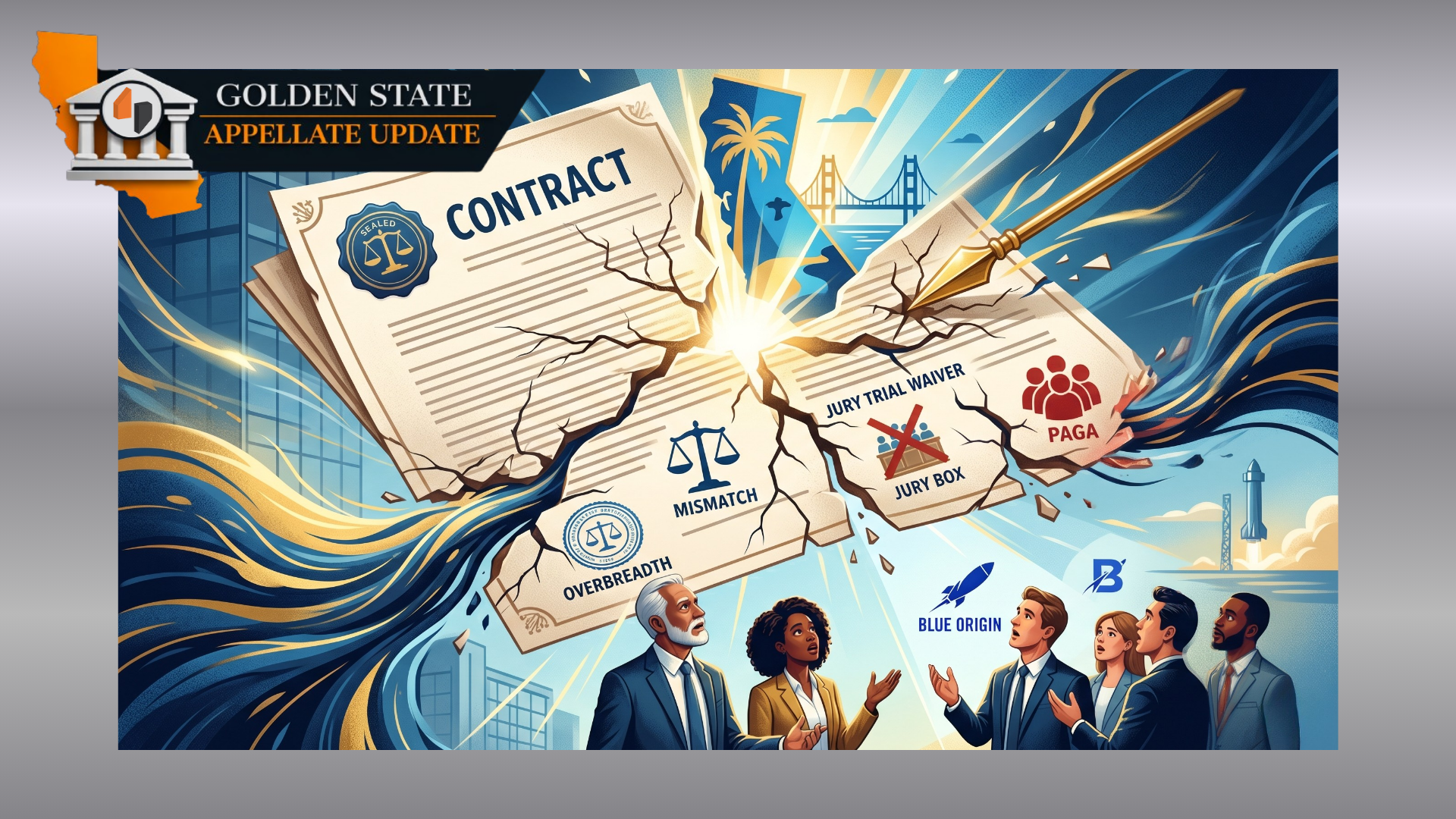
First, the agreement was overbroad. Its scope extended to “any and all claims, disputes, or controversies” between Stoker and Blue Origin, and “Blue Origin” was defined to include the parent company, subsidiaries, affiliates, successors, assigns, and all current and former officers, directors, employees, and agents. In the court’s view, that language swept in disputes far beyond the employment relationship. An arbitration agreement that captures virtually any conceivable claim against a sprawling corporate family is not a carefully scoped employment dispute resolution mechanism. It is a dragnet.
Second, the agreement lacked mutuality. The company carved out categories of claims it wanted to preserve while requiring the employee to arbitrate everything. One-sidedness in an adhesion contract is always a problem under California law, but when the employer’s carve-outs operate precisely to protect the employer’s most valuable interests while leaving the employee’s claims subject to arbitration, courts notice.
Third, and this one is striking, the agreement waived the right to a jury trial on claims that were not subject to arbitration. Read that again. For claims that the parties expressly agreed would not go to arbitration, the agreement still stripped the employee of the right to a jury. The court found no legitimate business justification for this. A jury trial waiver attached to non-arbitrable claims is simply the employer trying to have it both ways.
Fourth, the agreement’s representative action waiver swept in claims under the Private Attorneys General Act. Under California law, PAGA representative claims cannot be fully extinguished by individual agreement in this manner.
Any one of those defects, standing alone, might have been curable. Together, they were not. The agreement contained a severability clause, and Blue Origin argued the court should simply excise the bad parts and enforce the rest. The court declined. When the unconscionable provisions are pervasive and central to the agreement’s basic design, severance is not a repair mechanism. It is a reconstruction project the court is not obligated to undertake on the drafter’s behalf.
What Employers Should Take Away from This
The instinct when a case like this comes out is to look for the distinguishing fact, the thing that made this agreement uniquely problematic. Resist that instinct. The four defects the court identified in Blue Origin’s agreement are structural choices that appear in employer-drafted arbitration agreements across California every day. Overbroad scope, lack of mutuality, PAGA waivers, and jury trial waivers on non-arbitrable claims are not exotic provisions. They are common ones.
If your company’s arbitration agreement was drafted more than two or three years ago, it may predate a series of California appellate decisions, Stoker now among them, that have progressively tightened the standards for enforceability. An agreement that cleared judicial review under earlier precedent may have accumulated defects under newer case law. The appropriate response is not a one-sentence amendment. It is a full review against the current legal landscape.
For companies that genuinely value arbitration as a dispute resolution mechanism, and there are legitimate reasons to, Stoker is also a design roadmap. Scope the agreement to actual employment disputes. Build in real mutuality. Do not use the arbitration agreement as a vehicle for stripping employees of rights that California law does not permit them to waive. And understand that a severability clause does not insulate a poorly drafted agreement from complete invalidation when the problems run deep.
There is a separate issue that Stoker leaves unresolved: how California courts will apply the federal EFAA to cases where sexual harassment claims are alleged alongside other employment claims. That question will get answered in a future decision. When it does, the answer will matter significantly for employers defending mixed-claim complaints in the post-MeToo legislative environment. Watch for it.
Bottom Line
If your company uses an employment arbitration agreement, assume it has not been reviewed recently enough. Pull it out. Have counsel check it against Stoker and the decisions that preceded it. An agreement you cannot enforce in court is not a risk management tool. It is a false sense of security. Horst Legal Counsel works with employers and employees on arbitration enforceability and employment disputes. If you have questions about where your agreement stands, we are glad to take a look