
Summary
A California Court of Appeal just made it easier to bring class actions against hotels that use the "28-day shuffle" to avoid tenant protections. If you own, operate, or invest in extended-stay properties in California, Aerni v. RR San Dimas is a decision worth understanding.
Horst Legal Counsel | April 2026
If you own, operate, or invest in a hotel or extended-stay property in California, you have probably heard of the “28-day shuffle.” The playbook is familiar: require all guests to check out before they hit 30 consecutive days of occupancy, make them stay away for a few days, and then let them re-register. The goal is to keep guests in “transient occupancy” status indefinitely, which means no tenant protections, no eviction proceedings, and no obligations that come with a landlord-tenant relationship. Some operators have been running this policy for years under the assumption that as long as every guest gets the same treatment, the legal exposure is manageable.
A California Court of Appeal decision issued this month suggests that assumption deserves a second look.
The Hotel and the Policy
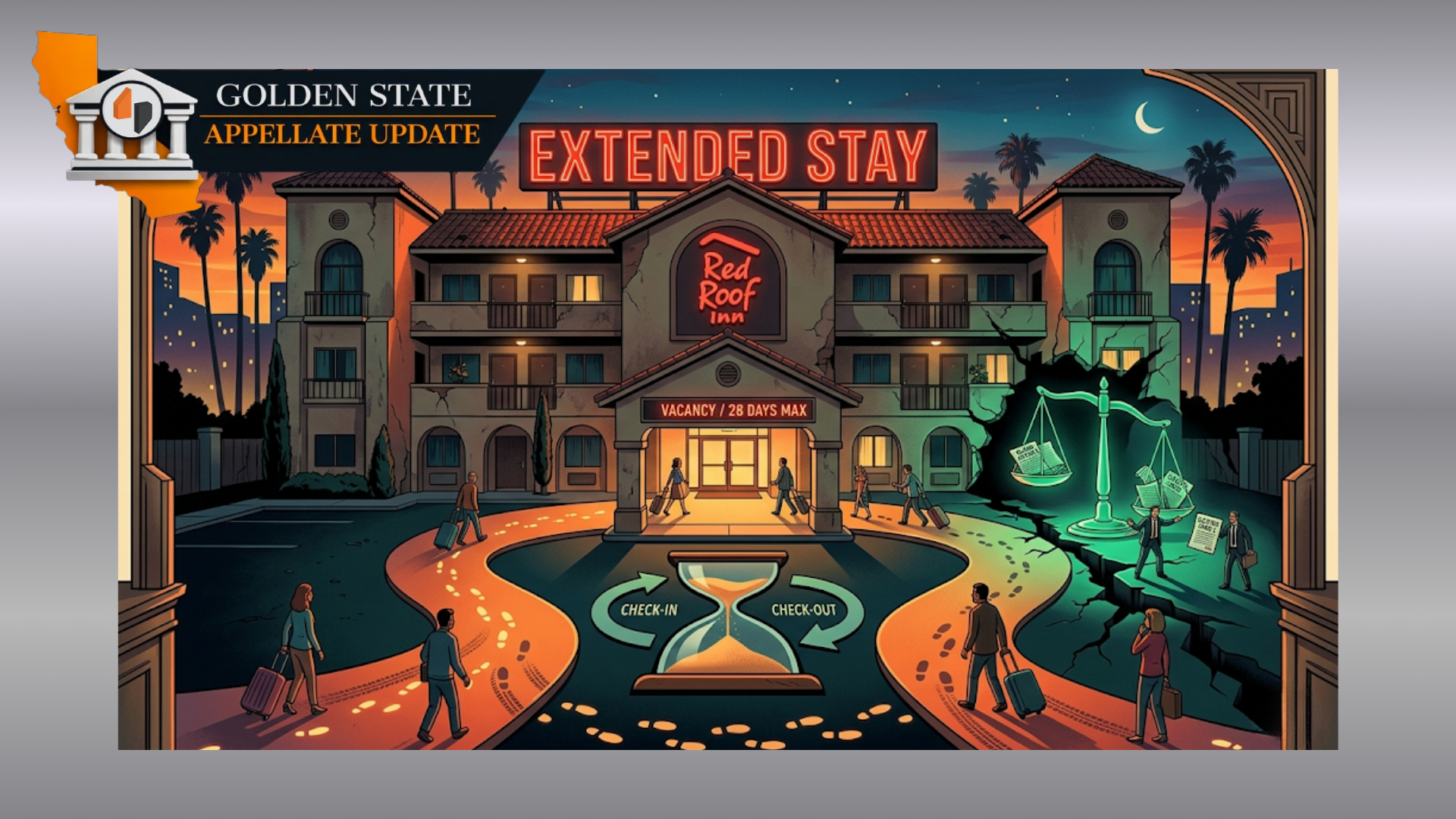
The defendants in Aerni v. RR San Dimas, L.P. (Cal. Ct. App., 2nd Dist., Apr. 16, 2026) own the Red Roof Inn in San Dimas, a 134-room economy hotel that has enforced a maximum 28-day stay policy for at least the past several years. The policy applies to every guest without exception. At check-in, guests are told verbally and in writing that their stay cannot exceed 28 consecutive days, and they are required to initial an acknowledgment of that limit. Anyone who reaches day 28 must vacate the property completely for at least three days before reregistering.
The hotel advertised itself on Craigslist as an “extended stay” property in the “apartments, housing for rent” section, with weekly rates of $427. Some guests had lived there for more than five years. Some listed the hotel address as their primary residence on their registration cards, a practice the hotel did not prohibit. A hotel principal testified, candidly, that the 28-day policy was designed in part to avoid lengthy eviction proceedings.
The two named plaintiffs stayed at the hotel in overlapping 28-day increments from June through November 2022. Each time they hit day 28, they left for the required three days, typically to their vehicle or another motel, then returned and reregistered. In November 2022, they filed a putative class action under Civil Code section 1940.1, the statute that prohibits the 28-day shuffle.
What the Statute Actually Says, and What It Does Not
Civil Code section 1940.1 was enacted to give residential hotel occupants a path to tenant protections once they have been in continuous occupancy for 30 days. The statute creates a private right of action for guests who can show three things: that they occupied a “residential hotel,” that the hotel required them to move out or re-register before 30 days, and that the purpose of that requirement was to keep them in transient occupancy status.
The definition of “residential hotel” comes from the Health and Safety Code, and it is where the litigation turned. A residential hotel is, roughly speaking, a multi-unit building used as guests’ primary residence, unless the building is primarily used by transient guests who have other primary residences.
The defendants moved to defeat class certification on the ground that each class member would need to prove individually that the hotel was their personal primary residence. The trial court agreed. Because the statute uses the phrase “primary residence” in defining what a residential hotel is, the court reasoned that liability required an individualized showing from each plaintiff about their own residential situation. That kind of individualized inquiry, the court held, prevents common issues from predominating, which kills class certification.
Where the Trial Court Got It Wrong
The Court of Appeal reversed. The error, the court explained, was treating a hotel-wide question as though it were a plaintiff-by-plaintiff one.
“Residential hotel” is a characteristic of the building, not of any individual guest. The statute asks whether the hotel as a whole is used as guests’ primary residence and whether it is primarily used by transient guests who have other homes. Those are questions about the property, answerable through occupancy data, duration-of-stay statistics, advertising practices, and the hotel’s own policies. They do not require the court to interrogate each of the potentially 1,700 class members about their personal living arrangements.
The court was careful to distinguish the only individualized element the statute actually contains: whether that specific plaintiff was required to check out before 30 days for the purpose of keeping them in transient status. That inquiry is individual. But the threshold question of whether this is a residential hotel to begin with is not. And because the trial court denied class certification on the basis of that threshold question alone, the denial was grounded in an erroneous legal assumption. That kind of legal error, regardless of whether there might otherwise be evidence to support the outcome, is grounds for reversal.
The court also acknowledged that the statute has real ambiguities, including what percentage of non-transient guests makes a building “residential,” and how to assess a hotel’s status if its occupancy patterns change over time. It was candid enough to tell the Legislature to fix those gaps. For now, those questions go to the merits of the claims, not to whether a class should be certified. They will be litigated another day.
What This Means for Property Owners and Investors
The practical implications extend beyond the Red Roof Inn in San Dimas.
Any California hotel or extended-stay property that systematically enforces sub-30-day checkout policies should treat this decision as a signal to audit its exposure. The fact that a policy applies uniformly to all guests is not a shield against class treatment. If anything, a written, uniform policy applied to hundreds of guests over multiple years is precisely the kind of common evidence that makes class certification possible. The hotel’s own testimony that the policy was designed to avoid tenant relationships, combined with advertising that targeted long-term occupants, will not look favorable when the case goes back to the trial court.
For buyers and lenders evaluating hospitality or extended-stay assets, this decision adds a diligence item that has not always appeared on the checklist. If a property has a history of 28-day checkout cycles, if it markets itself to long-term guests, and if its occupancy data shows a meaningful proportion of stays that cluster just below 30 days, the exposure under section 1940.1 is real and, after Aerni, potentially certifiable as a class action. That is the kind of contingent liability that belongs in a purchase agreement representation, not a post-closing surprise.
For operators who are currently running variations of the 28-day policy, the decision counsels caution. The statute’s ambiguities remain unresolved, and the trial court has yet to decide the merits of the underlying claims. But the class certification hurdle, which defendants in these cases have historically used as an effective early exit, just became harder to clear.
The Bottom Line
The 28-day shuffle has always been legally questionable. What Aerni adds is a practical reality: the legal theory behind it is now more easily litigated as a class action. Hotel operators who rely on uniform checkout policies to avoid tenant relationships may find that the uniformity of the policy is exactly what allows a class to be certified against them. The case goes back to the trial court, the merits are still live, and the statute’s ambiguities are genuinely unresolved. But the path to a certified class of displaced guests, potentially numbering in the thousands, is now open, and property owners should be thinking carefully about what their records, their testimony, and their advertising will look like when that litigation arrives.
Real estate litigation involving landlord-tenant disputes, habitability claims, and property owner liability is a core part of Horst Legal Counsel’s practice. If you have questions about how Aerni affects your property or portfolio, we are glad to talk through it. Contact us here.