
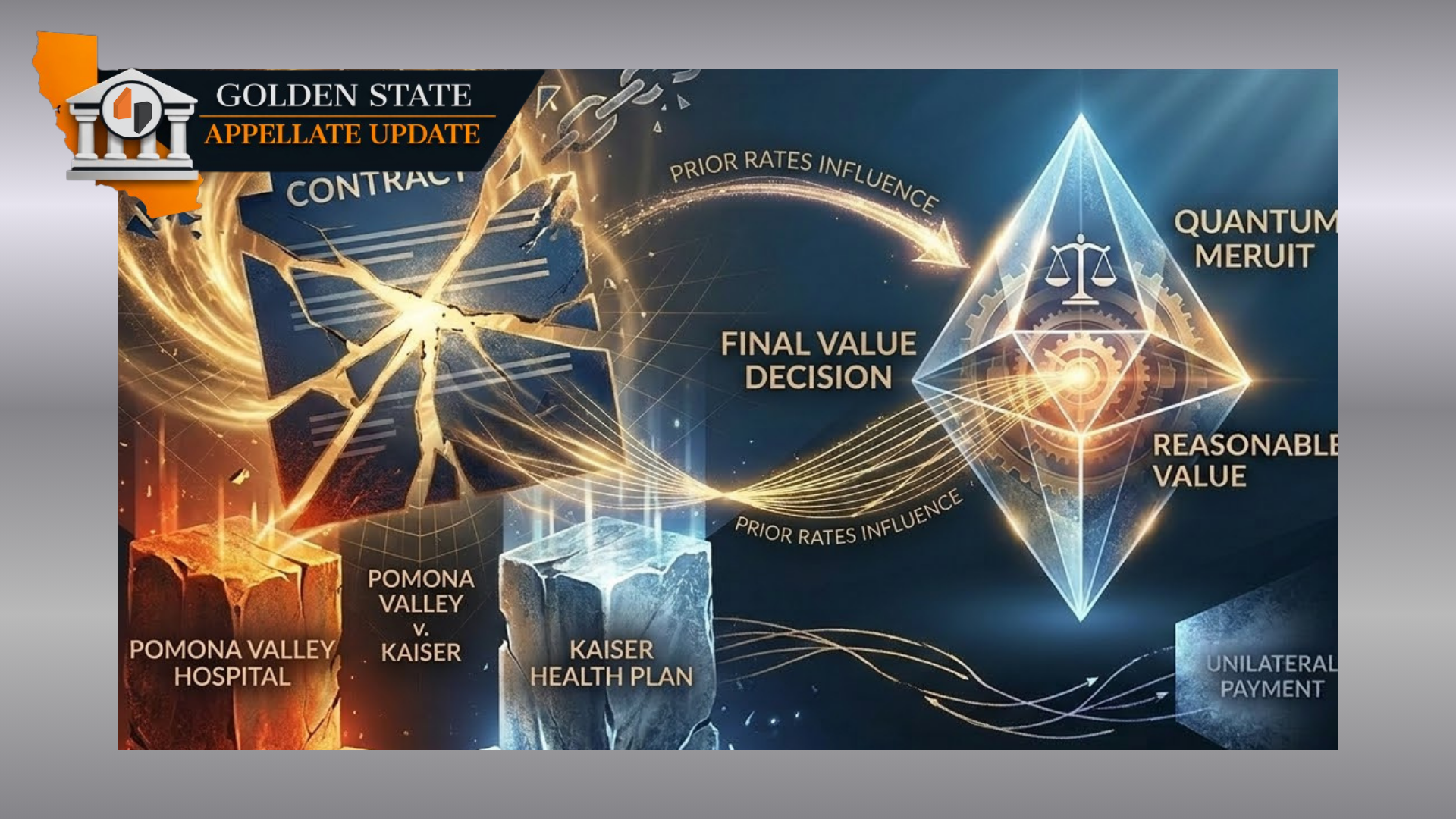
Court of Appeal Holds Prior Contract Rates May Still Matter After the Contract Ends
Horst Legal Counsel | March 2026
When a contract ends, parties often assume the old deal is no longer part of the story. This case is a reminder that assumption is not always right.
In Pomona Valley Hospital Medical Center v. Kaiser Foundation Health Plan, Inc., the California Court of Appeal addressed what happens after a long running reimbursement agreement is terminated and the parties move into a dispute over the reasonable value of services. Kaiser argued that once the contract ended, the prior agreement had no role in determining what the hospital should be paid. The Court of Appeal disagreed.
Pomona Valley Hospital and Kaiser had operated under a reimbursement contract dating back to 2004. After Kaiser terminated the agreement, the hospital continued providing emergency services to Kaiser members, and Kaiser began paying what it unilaterally considered the reasonable value of those services. The hospital sued in quantum meruit, alleging Kaiser had underpaid by tens of millions of dollars for services provided between late 2017 and early 2020.
At trial, the hospital introduced evidence of the parties’ prior contract rates as part of its proof of value. The jury found in the hospital’s favor. After the verdict, however, the trial court concluded that the prior contract should not have been admitted into evidence and granted Kaiser’s motion for a new trial, while also offering remittitur as an alternative. That ruling set up the appeal.
The core issue before the Court of Appeal was whether the prior contract rates could still be considered as evidence of reasonable value, even though the contract itself had already been terminated. The court held that they could.
The appellate court explained that the jury was not being asked to enforce the old agreement. It was being asked to determine the reasonable value of the services the hospital had provided. In that context, the parties’ historical contract rates were relevant evidence the jury could consider along with the rest of the valuation record. The court therefore rejected the idea that the prior agreement was categorically off limits simply because the legal theory had shifted from contract enforcement to quantum meruit.
That distinction matters. In many business disputes, the real fight begins after the contract ends. The legal framework changes, but the economic history between the parties does not disappear. A prior pricing arrangement may still become important evidence of what both sides previously accepted as fair, and that history can shape how a court or jury evaluates a later claim for reasonable value.
The Court of Appeal did agree with Kaiser on one point. It held that the prejudgment interest rate applied below should be reduced from 10 percent to 7 percent. But on the central evidentiary issue, the court concluded the trial court had erred in treating the prior contract as inadmissible and in granting a new trial on that basis.
Why This Case Matters
Although this opinion arose in the healthcare reimbursement context, its logic extends well beyond that setting. Service providers, vendors, contractors, and businesses in long term commercial relationships often end up in disputes after an agreement is terminated. When payment claims shift into quantum meruit or other reasonable value theories, the parties’ prior course of dealing may still carry real evidentiary weight.
That makes this case a useful reminder that a terminated contract is not always a dead document. Even if it no longer governs the parties’ rights, it may still shape the valuation battle that follows.
Bottom Line
Pomona Valley Hospital Medical Center v. Kaiser Foundation Health Plan, Inc. shows that when a contract ends, the dispute does not necessarily start from zero.
The legal claim may change, but the prior deal may still matter. For businesses involved in posttermination payment disputes, that pricing history may become one of the most important parts of the case.