
Court of Appeal Affirms Pet Custody Order, Despite Trial Judge’s Reliance on AI-Hallucinated Case Citations
Horst Legal Counsel | March 2026
Reviewing a judicial order that analyzed parties’ respective rights under AI-hallucinated case law cited and “interpreted” extensively by the parties, the Court of Appeal in Torres Campos v. Munoz felt compelled to publish its opinion in order to send a clear message to all officers of the court, whether at bar or on the bench:
“In a system of precedents that is designed to achieve consistency, predictability, and adherence to the rule of law, the judiciary cannot function properly unless judges and lawyers confirm the authenticity of cited authorities and review them to evaluate their holdings and reasoning. When the participants fail to perform this basic function, it compromises these institutional values and diminishes faith in the judicial process.”
In Torres Campos, the court confronted a family court order that relied on two entirely fictitious cases. The appellate panel agreed the trial court abused its discretion by basing its ruling on nonexistent authority. The Court nonetheless upheld the order, finding that appellant, whose own lawyer had drafted and submitted the very order that included the fake citations, had forfeited his right to challenge the order.
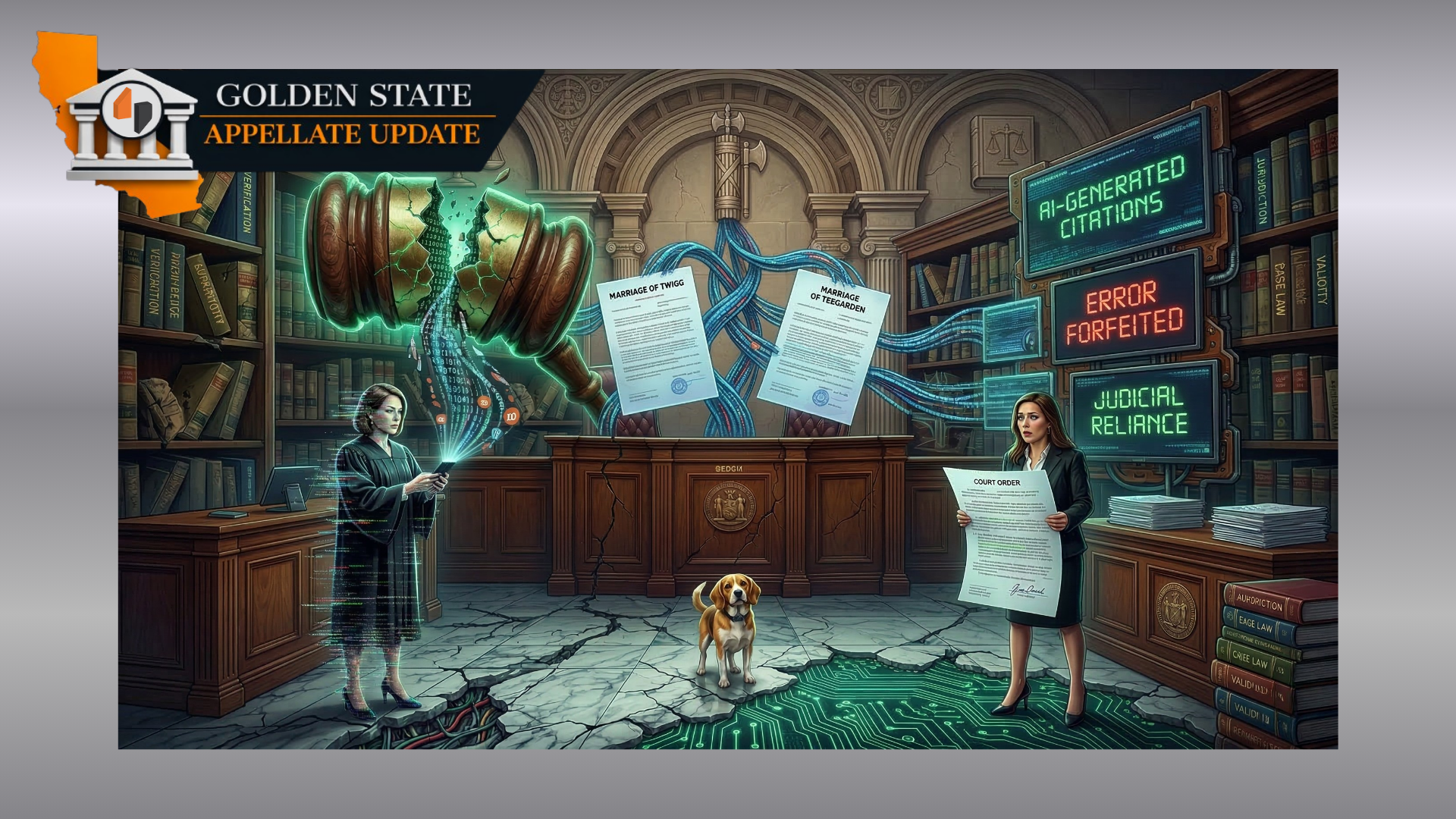
The case represents perhaps the most egregious single instance of AI hallucinations infecting the judicial process. A woman with custody of the dog she had shared with her ex-domestic partner told the family court that Marriage of Twigg and Marriage of Teegarden controlled her ex’s claim for custody over the dog. After a hearing, her ex’s lawyer submitted a proposed order to the court citing Marriage of Twigg and Marriage of Teegarden. The family court then adopted that proposed order, finding that, under Marriage of Twigg and Marriage of Teegarden, the ex receiving visitation rights was not in the best interests of the parties.
The problem? Both Marriage of Twigg and Marriage of Teegarden were AI-hallucinated cases.
How the Fake Citations Got Into the Record
The underlying dispute was a pet custody fight in San Diego family court. Joan Pablo Torres Campos sought shared custody and visitation of a dog named Kyra after his domestic partnership with Leslie Ann Munoz was dissolved. Munoz was represented pro bono by her cousin, Roxanne Chung Bonar, who cited the two fictitious cases in a letter opposing Torres’s motion, in Munoz’s declaration, and in filings in the Court of Appeal. Neither Twigg nor Teegarden, as cited, exists. The official citation Bonar provided for Twigg actually corresponds to an unrelated criminal case, and her citation for Teegarden misidentified the year, volume, and subject matter of a real but irrelevant spousal support decision.
After a hearing, the court directed Torres’s counsel to prepare a formal order. Torres’s counsel drafted that proposed order—and included the fictitious citations in the court’s reasoning. The commissioner signed it.
Forfeiture: You Can’t Challenge an Error You Created
On appeal, the Fourth District agreed that relying on fabricated case law constitutes an abuse of discretion, calling it “fundamentally incompatible with an informed exercise of discretion controlled by genuine principles of law.” But the court held Torres forfeited the claim under the doctrine that bars a party from challenging an error on appeal when that party caused or failed to correct the error below.
Torres’s own counsel had drafted the proposed order containing the hallucinated citations. She submitted it without verifying the authorities and without flagging the problem. The court found both affirmative conduct, drafting the order, and inaction, failing to object, supported forfeiture. The panel declined to exercise its discretion to overlook the forfeiture, reasoning that doing so would effectively excuse counsel’s own breach of her duty to the court.
Sanctions and a State Bar Referral
Bonar’s conduct drew direct consequences. When the issue was first raised on appeal, she defended the fictitious cases as legitimate, calling Torres’s challenge “baseless” and “unfounded.” She doubled down by providing additional fabricated parallel reporter citations and a fictitious date of decision for Twigg. She later acknowledged that the original citations came from a Reddit article shared at a family dinner and admitted she lacked a paid legal research subscription. At oral argument, she conceded the additional fictitious citation details may have come from AI tools.
The court imposed $5,000 in sanctions—significantly higher than the $1,500 and $1,750 imposed in the earlier Alvarez and Schlichter decisions, citing two aggravating factors: Bonar persisted in defending the fake authority even after being alerted to it, and she never fully explained where the additional fabricated citation information came from. The court also referred Bonar’s conduct to the State Bar.
Bottom Line
Torres Campos v. Munoz is the first published California appellate decision to directly address a trial court’s reliance on AI-hallucinated case citations in its own order. That distinction matters. Prior decisions like Alvarez, Schlichter, and Noland sanctioned attorneys for submitting fake citations. Torres Campos confronts what happens when fabricated law passes through every checkpoint, opposing counsel, drafting counsel, and the bench, and becomes the stated basis for a judicial order.
The court chose to publish its opinion for a reason. Its message was directed not only at the lawyers who failed here, but at the system itself. When a court order cites nonexistent authority as the legal basis for its ruling, the institutional values the court identified in its opening, consistency, predictability, and adherence to the rule of law, are not just compromised. They are absent. The court recommended that the Judicial Council consider adopting guidelines or rules for verification of citations, particularly in orders drafted by the parties and submitted to the court for signature.
That recommendation reflects the reality that the current safeguards failed at every level. Bonar cited fake cases. Torres’s counsel incorporated them into a proposed order without checking. The commissioner signed it. No one in the process did the basic work of confirming that the cited authorities were real. As AI tools become more embedded in legal research and drafting, every participant in the system, lawyers and judges alike, bears responsibility for ensuring that the law being applied actually exists.