
Horst Legal Counsel | April 2026
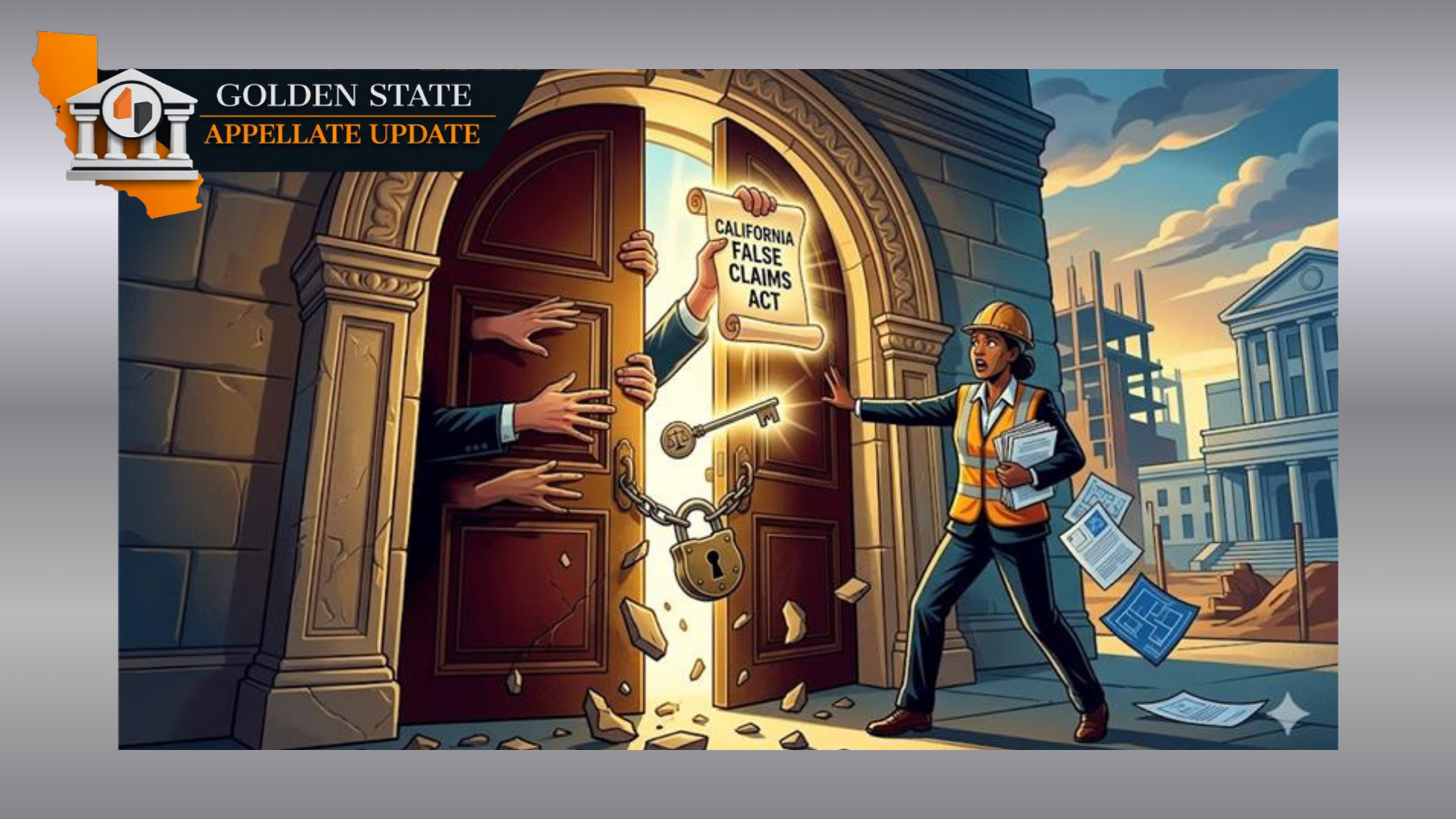
If your company does construction work for a California city or county, you need to know about a case the Second District Court of Appeal just published. The short version: any private individual with knowledge of fraud against public funds can sue you under the California False Claims Act, and the procedural technicalities you might have counted on to make the case go away no longer work the way defendants thought they did.
In Albarghouti v. LA Gateway Partners, LLC (2d Dist., April 2, 2026), the Court of Appeal reversed the dismissal of a qui tam lawsuit against two companies involved in construction projects at Los Angeles International Airport. The court’s reasoning reshapes how the CFCA’s procedural requirements work in practice, and it tilts the playing field toward private whistleblowers in a meaningful way.
What Happened
Jamal Albarghouti filed a qui tam complaint in May 2022 alleging that LA Gateway Partners and PCL Construction Services submitted false claims to the Los Angeles Department of Water and Power and Los Angeles World Airports in connection with LAX construction projects. Under the CFCA, a private individual (called a “relator”) can bring suit on the government’s behalf when they discover fraud against public funds. The incentive is significant: if the government doesn’t intervene, the relator can collect between 25 and 50 percent of the proceeds recovered in the action.
Albarghouti followed the statutory playbook. He filed his complaint under seal, mailed a copy to the Attorney General by certified mail with return receipt requested, and noted on the required Judicial Council form that the seal would expire 60 days later, on July 26, 2022. Then he waited.
Here’s where things went sideways. Because the case involved political subdivision funds (not state funds), the Attorney General’s office was supposed to forward the complaint to LADWP and LAWA within 15 days. It didn’t. An internal error at the AG’s office meant the complaint never reached the local prosecuting authorities. Nobody sought to extend the seal. Nobody notified the court of a decision to intervene or decline.
After the 60 days passed, Albarghouti served the defendants and began litigating. The defendants demurred, arguing he had “prematurely” broken the seal by serving them before the Attorney General notified the court of its decision. The trial court agreed and sustained the demurrer without leave to amend, effectively killing the case.
What the Court of Appeal Decided
The Second District reversed on two independent grounds, both of which matter for businesses facing qui tam exposure.
The seal lifts automatically after 60 days. The court held that the CFCA creates a default 60-day sealing period. When that period expires and the government has neither requested an extension nor notified the court of its intervention decision, the seal lifts on its own. The statute says the complaint “may remain under seal for up to 60 days.” The court read that language to mean exactly what it says: 60 days is a ceiling, not a floor. The defendants argued the seal stays in place indefinitely until the government acts. The court rejected that reading, noting it would render the 60-day language meaningless and would perversely reward governmental inaction. Under the defendants’ theory, the government could extend the seal forever simply by doing nothing, without ever having to show the “good cause” the statute requires for formal extensions. The court found that result inconsistent with both the statutory text and the Legislature’s intent to encourage private enforcement of the CFCA.
Procedural noncompliance doesn’t automatically kill the case. Following the U.S. Supreme Court’s reasoning in State Farm Fire and Casualty Co. v. U.S. ex rel. Rigsby (2016), the court held that a relator’s failure to comply with the CFCA’s sealing and service requirements does not mandate automatic dismissal. The CFCA specifies dismissal as the remedy for other kinds of violations (like cases based on publicly disclosed information), but it says nothing about dismissal for seal violations. That silence, the court reasoned, was intentional. Compliance with sealing procedures isn’t even something a qui tam plaintiff can allege at the time of filing, because most of the requirements involve post-filing actions. A demurrer was the wrong vehicle to challenge compliance.
The court also dispatched the defendants’ standing argument. They claimed Albarghouti lacked standing to pursue the case because the government never “assigned” him the right to proceed. The court pointed to the plain language of section 12652, which authorizes a qui tam plaintiff to bring the action without any prior governmental approval, and which allows the plaintiff to remain a “full party” even if the government does intervene.
Why This Matters for Your Business
This decision changes the practical calculus for any company that does business with California’s state or local governments. Here’s what you should take from it.
First, procedural defenses are weaker than they used to be. Before Albarghouti, defendants in qui tam cases could reasonably hope that a relator’s missteps in the sealing process would provide grounds for dismissal. That argument just lost significant ground. The court made clear that compliance with sealing requirements isn’t even a pleading element of a CFCA cause of action, and that noncompliance doesn’t trigger automatic dismissal. If you’re a defendant in a qui tam action, your defense needs to be built on the substance of the claims, not on procedural foot faults.
Second, the 60-day clock is real. The government can no longer sit on a qui tam complaint indefinitely while the seal stays in place. If the AG’s office doesn’t act within 60 days, the relator can move forward. For businesses, this means you could be served with a qui tam lawsuit as soon as 60 days after filing, with no ambiguity about whether the relator jumped the gun. The timeline is now clear and predictable.
Third, internal compliance matters more than ever. When procedural defenses shrink, substantive defenses become the whole ballgame. If your company holds government contracts, the best protection against a qui tam suit is making sure your billing practices, reporting, and contract performance can withstand scrutiny. An employee who sees irregularities now has a clearer, faster path to the courthouse.
Bottom Line
The Albarghouti decision makes it easier for private whistleblowers to bring False Claims Act suits against government contractors in California, and harder for defendants to escape those suits on procedural grounds. If your business works with public agencies, the time to audit your compliance practices is before a relator files, not after.
Horst Legal Counsel advises businesses on litigation risk, government contract exposure, and dispute resolution strategy. If you have questions about how this decision might affect your operations, we’re here to help.