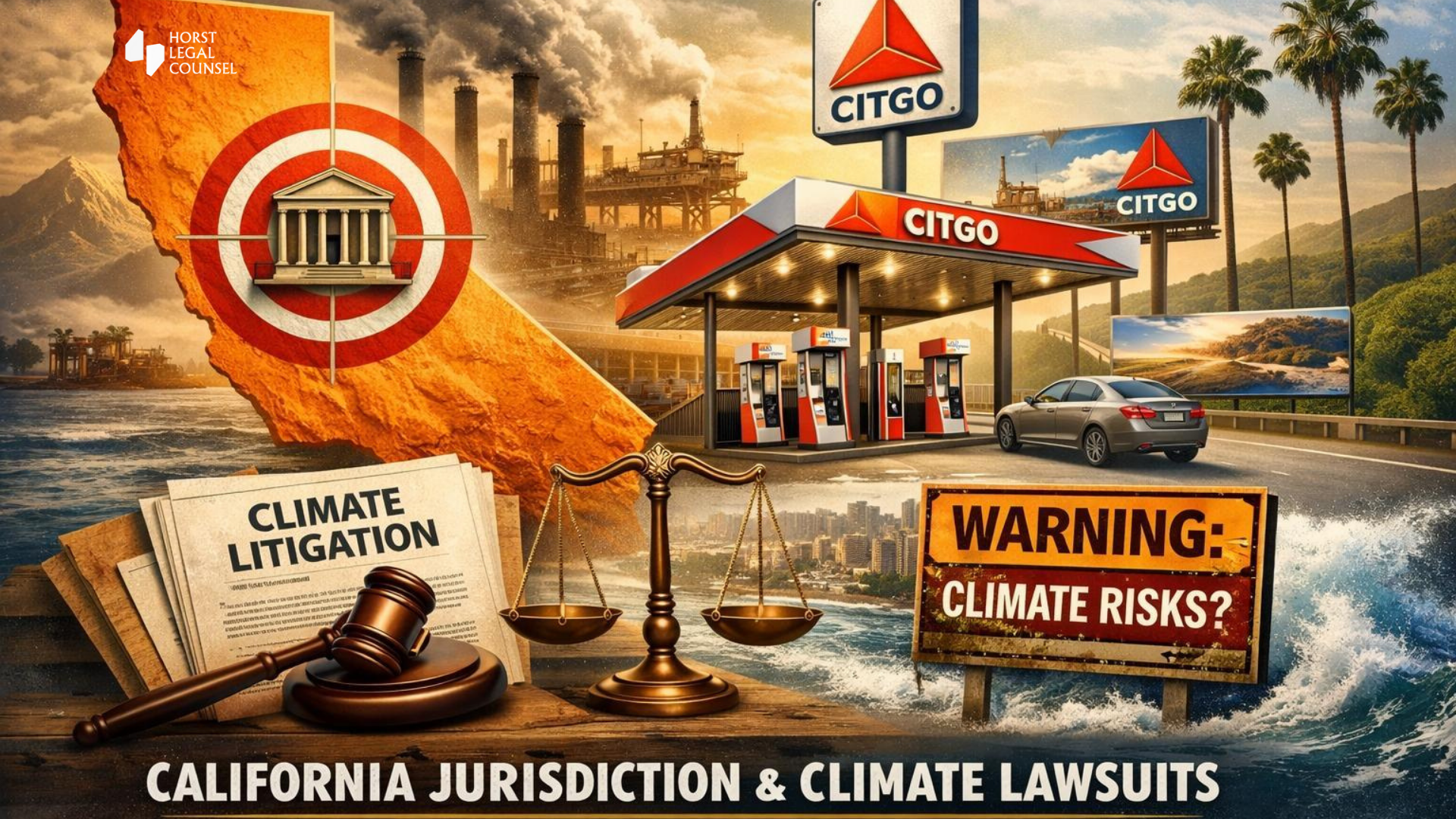
California’s latest climate decision, In re Fuel Industry Climate Cases, pushes the law of specific personal jurisdiction another step forward—and national businesses that sell, brand, or market into the state should pay attention. The First District Court of Appeal held that California courts can exercise specific jurisdiction over Citgo Petroleum, an out-of-state company, based on decades of branded gasoline sales and in-state marketing, even though Citgo positioned itself as a “middleman” rather than a California refiner or retailer.
For companies that do business nationwide, the opinion is a concrete reminder that California specific personal jurisdiction after Ford Motor is not limited to direct, in-state conduct by local affiliates. If you build a California market over time—through contracts, branded products, and consumer-facing marketing—California courts may be prepared to hear wide-ranging tort and nuisance claims tied to that activity.
The Dispute: Climate Nuisance Claims and a Motion to Quash
The plaintiffs are several California cities, counties, and a flood/sea-level resiliency district suing a group of fossil-fuel companies. They allege that greenhouse gas pollution from defendants’ fossil fuel products, combined with long-running “disinformation campaigns” about climate risks, has caused significant damage to California communities. The complaint includes public nuisance, private nuisance, negligence, strict liability failure-to-warn, and trespass claims.
Citgo, a non-California company, moved to quash service of summons for lack of personal jurisdiction. It argued that its California conduct was limited: it did not refine gasoline in California, and it simply bought gasoline from California refiners and supplied it to retailers like Sears, 7-Eleven, and Jack in the Box. Any “marketing,” Citgo said, consisted of minimal point-of-purchase branding material. The trial court agreed and granted Citgo’s motion while denying a joint motion to quash by other oil company defendants. Plaintiffs appealed.
The Legal Issue: How Far Does “Relate To” Reach?
On appeal, the question was whether California courts could exercise specific personal jurisdiction over Citgo consistent with due process. Under Ford Motor Co. v. Montana Eighth Judicial Dist. Court, specific jurisdiction exists when:
- The defendant purposefully avails itself of the forum;
- The plaintiff’s claims arise out of or relate to the defendant’s forum contacts; and
- Exercising jurisdiction is reasonable.
Citgo conceded purposeful availment, so the First District focused on prongs (2) and (3). Because the relevant jurisdictional facts (Citgo’s historical contracts and activities in California) were undisputed, the court reviewed the issue de novo.
The Court’s Holding: Branded Sales + No Warnings = Jurisdiction
The court concluded that the plaintiffs’ claims “arose out of or related to” Citgo’s California contacts and that exercising jurisdiction was fair.
On the contacts side, the court emphasized that:
- From the 1980s into the 2000s, Citgo operated and supplied hundreds of Citgo-branded gas stations at Sears, 7-Eleven, and Jack in the Box locations in California.
- Citgo’s agreements went well beyond bulk sales; Citgo leased premises, operated some locations, and required use of Citgo trademarks and point-of-purchase branding, while controlling how that branding appeared.
- Citgo agreed to fund millions of dollars in marketing spend to “enhance the CITGO brand” at California sites and contracted with California suppliers and trucking companies to move significant volumes of fuel.
The plaintiffs’ theory, importantly, was not just “you sold fuel that emitted greenhouse gases.” Their complaint stressed failure to warn and deceptive marketing: Citgo allegedly promoted branded gasoline in California while omitting warnings about climate-related risks. The court treated Citgo’s in-state distribution and branding decisions—and the absence of climate warnings in that branding—as a meaningful part of the alleged tort, not a remote background fact.
Under Ford Motor, the court rejected Citgo’s demand for a tight but-for causal chain linking each California gallon of fuel to specific climate injuries. It was enough that Citgo’s deliberate, long-running California activities—selling and branding fossil fuel products without warnings—were substantially connected to the climate-related harms and failure-to-warn claims at issue.
On the fairness prong, Citgo failed to show that litigating in California would be unreasonable, given its extensive profit-seeking activities in the state and California’s strong interest in adjudicating alleged climate harms affecting its residents and infrastructure. The court therefore reversed the order granting Citgo’s motion to quash.
Why This Matters for Businesses Doing Business in California
For companies with a California footprint—Fuel Industry Climate Cases offers several practical lessons about California specific personal jurisdiction:
- Indirect doesn’t mean safe. You don’t need California facilities or a local subsidiary to end up in California court. Contracting with California retailers, controlling branding, and funding marketing can be enough.
- Branding is marketing. The court treated Citgo’s trademarks and point-of-purchase materials as real advertising, not mere “logos.” If your brand invites consumer trust, courts may fold that into the jurisdiction and liability analysis.
- Failure-to-warn theories travel. When claims focus on what you did (or didn’t) tell consumers about product risks, any state where you promoted or sold that product is a potential forum.
- Nationwide strategies can create California exposure. Multi-state campaigns, industry-wide messaging, and trade-association work can be tied back to your California sales and marketing footprint.
Practical Takeaways for In-House Counsel and Risk Managers
If your company sells or brands into California, this decision is a good prompt to review:
- Distribution and branding contracts. How much control do you exercise over branding, in-store materials, and local promotions? The more control, the more likely a California court will see you as doing business here for jurisdiction purposes.
- Product warnings and risk disclosures. Are California consumers receiving materially different information or fewer warnings than consumers elsewhere? Climate, environmental, and health-risk disclosures are likely targets.
- Litigation posture in multi-state cases. If you are sued in California on a product or systemic-harm theory, Ford Motor and Fuel Industry Climate Cases together make jurisdictional motions a harder sell—especially where you’ve invested in building a California market over time.
If you have questions about how this case impacts your business, reach out to Horst Legal Counsel now!