
Summary
A California Court of Appeal decision, Dawadi v. Adhikari (April 2026), confirms that informal acts like partial payments and check memo notations are not enough to revive a debt after the statute of limitations has expired. Once the four-year clock under Code of Civil Procedure section 337 runs out on a written contract claim, only a signed, unqualified, written acknowledgment from the debtor can create a new cause of action. This post explains what the court decided, why it matters for California lenders, businesses, and individual creditors, and what to do when you are holding an aging receivable.
If your business is sitting on an old written loan that the borrower never repaid, and the only thing keeping your hopes alive is a couple of small, sporadic payments that arrived years after the due date, the California Court of Appeal just handed down a decision you should read carefully. Not because it broke new ground. Because it confirmed, with unusual specificity, that the legal theory most creditors instinctively reach for in this situation does not work.
The case is Dawadi v. Adhikari (Cal. Ct. App., 4th Dist., Div. One, No. D086131, filed Apr. 16, 2026, certified for publication May 12, 2026). The facts are unremarkable. The lesson is not.
The Facts That Got Dawadi Here
In January 2015, Bhaskar Dawadi loaned money to Pradhi, Inc., a corporation controlled by Prasanna Adhikari. The parties memorialized the deal in a written agreement that called for repayment within one year at zero interest. The repayment deadline came and went in January 2016 with nothing paid.
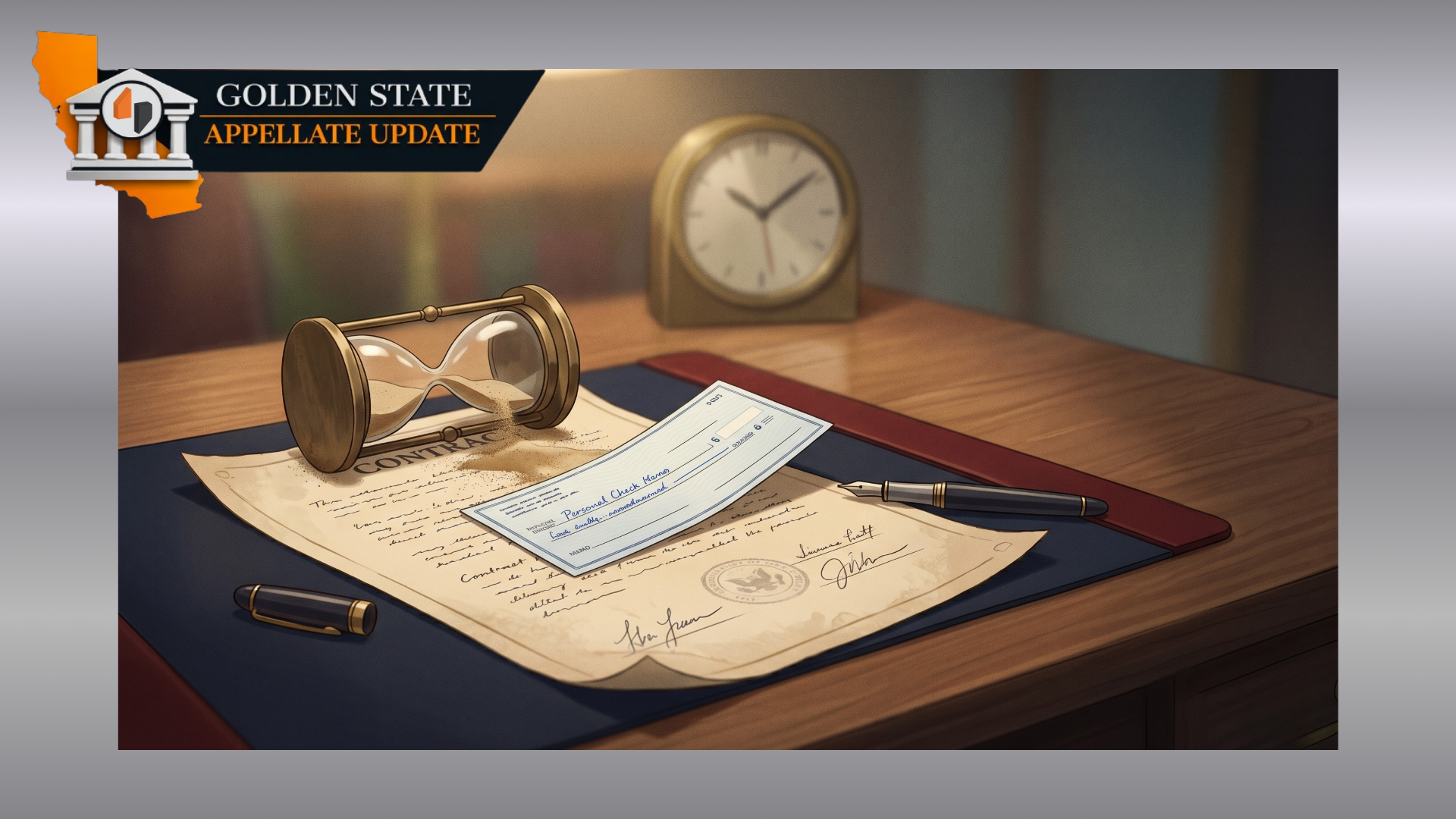
More than five years later, in June 2021, Adhikari began sending Dawadi small payments. Three of them, $1,000 each. The first two checks bore a memo line that read “BR Dawadi-Pradhi Loan Payment.” The third, sent in November 2023, said only “Payment.” Adhikari later denied ever having borrowed the money, and refused Dawadi’s request for a personal guarantee.
Dawadi filed suit in July 2024, asserting two causes of action for breach of contract and one for fraud in the inducement. The defendants demurred on multiple grounds, including the statute of limitations. The trial court sustained the demurrer without leave to amend, holding that the four-year limitations period under Code of Civil Procedure section 337 had expired in January 2020, more than four years before Dawadi filed suit. Dawadi appealed.
What the Court Actually Decided
The Court of Appeal affirmed. Justice Kelety, writing for the panel, walked through the analysis with care because the answer turns on a doctrinal distinction that catches creditors and their counsel by surprise more often than it should.
California law treats acknowledgments of debt differently depending on when they happen. An acknowledgment made before the limitations period expires merely continues the original obligation through a fresh statutory period. It does not create a new cause of action. It resets the clock. An acknowledgment made after the limitations period has already run is a different animal. It does not extend anything, because the original cause of action is already gone. Under the right circumstances, it creates a brand new contract, with a fresh four-year clock running from the date of the acknowledgment itself.
Code of Civil Procedure section 360 governs both situations. It requires the acknowledgment to live in a writing signed by the party to be charged. Partial payments work too, but only if they happen before the limitations period expires. The statute is explicit on the rest: “no such payment of itself shall revive a cause of action once barred.”
That rule disposed of the three $1,000 payments on its own. They all arrived after January 2020, after the four-year clock had run, so section 360 took them off the board.
Dawadi’s real argument was different. He contended that the memo notation on the first two checks, “BR Dawadi-Pradhi Loan Payment,” counted as a written acknowledgment sufficient to create a new contract under Western Coal and Mining Co. v. Jones (1946) 27 Cal.2d 819. The court rejected that argument for three reasons, each pointing the same direction.
First, the legal standard for a post-expiration written acknowledgment is exacting. The acknowledgment must be “direct, unqualified, and unconditional,” a flat admission of the debt paired with an implicit promise to pay it. Categorizing a payment on a memo line does not clear that bar. It identifies a payee and labels a transaction for accounting purposes. It does not state the amount owed, it does not promise the remaining balance, and it does not waive any defense.
Second, the surrounding circumstances pointed in the opposite direction. Dawadi’s own complaint alleged that Adhikari refused his request to revive the debt and later denied ever having borrowed the money. Under Western Coal, a qualifying expression that repels the idea of an intention to pay defeats the acknowledgment theory. An express denial of the underlying debt is about as qualifying as it gets.
Third, the original written loan agreement contained an integration clause and required any amendment to be in writing and signed by both parties. A unilateral memo notation does not satisfy a bilateral amendment requirement.
The contrast with Western Coal did the rest of the work. There, the parties executed a new, separate written agreement, signed by both sides, that expressly referenced the underlying obligations. That kind of formal, mutual instrument is a different document from a casual memo on a check. The trial court correctly drew the line, and the Court of Appeal endorsed it.
What Lenders and Creditors Should Take Away from This
The instinct, when you discover that your statute of limitations has run on a written contract claim, is to grasp for something the debtor said or did recently that might revive the obligation. Partial payments. A casual email acknowledging the debt. A verbal admission. A memo line on a check. Dawadi should temper that instinct hard.
If the limitations period has already expired, only one thing reliably revives the cause of action: a signed, unqualified, written acknowledgment of the debt by the debtor, ideally paired with a fresh promise to pay. The cleaner and more standalone the writing, the better. Anything less than a deliberate, dedicated document risks getting picked apart for ambiguity, for the qualifying circumstances around it, or for failing to satisfy the original contract’s amendment requirements.
A few practical implications follow. When a debtor on a stale obligation reaches out, the first move is documentation, not collection. Get a written acknowledgment of the outstanding balance and a fresh promise to pay before you accept the next check. If the debtor will not sign one, the partial payments they keep sending are gestures, not legal rescue.
When you draft a loan agreement on the front end, recognize that integration clauses and amendment-by-signed-writing requirements cut both ways. They protect you against unauthorized modifications. They also block informal revivals if the debt later goes stale. Decide which risk matters more for your portfolio before the boilerplate gets locked in.
And when the four-year clock is close to running, do not wait. A pre-expiration acknowledgment under section 360 only needs a writing signed by the debtor, and it is significantly easier to obtain than a post-expiration acknowledgment that has to clear the Western Coal standard.
Bottom Line
A debt that has aged past its statute of limitations does not disappear in any moral sense, but the legal remedy for it is gone unless something specific revives it. Partial payments alone will not do the job. Memo line notations will not do the job. Casual references to the obligation will not do the job. What does the job is a written, signed, unqualified acknowledgment, drafted with the Western Coal standard in mind and the original contract’s amendment clauses respected.
If you are sitting on an aging receivable, the time to act on it is well before the four-year mark. If the mark has already passed, the path forward is narrow but it exists. Horst Legal Counsel works with lenders, businesses, and individual creditors on debt enforcement, statute of limitations strategy, and the contract drafting decisions that determine whether your remedies survive the calendar. If you have questions about a specific obligation, we are glad to take a look.